
Frank Lloyd Wright
1867-1959
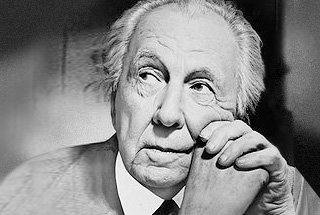
In 1867, just two years after President Lincoln’s assassination, Frank Lincoln Wright was born to William Cary Wright and Anna Lloyd-Jones. Influenced by his father’s love of classical music and his mother’s creative teaching methods, young Frank was introduced to famous architecture through drawings and paintings. His mother believed he was destined to be an architect and design great buildings. Upon the divorce of his parents, Wright changed his name to Frank Lloyd Wright to honor his mother’s family. Eventually his family relocated to Madison, Wisconsin, where Wright attended Madison High School, but never graduate.
As a teen, Wright worked on his uncle’s farm developing an appreciation of nature and a love for architecture. Upon abandoning high school, he went to work for the dean of the Engineering Department at the University of Wisconsin and spent some time at the University studying engineering. In 1887, he relocated to Chicago, Illinois.
In Chicago, Wright was given the opportunity to draft his first building, the Unity Chapel. Within a year, he was working directly under local famed architect, Louis Sullivan. Louis Sullivan would be the one to teach Wright that “form follows function,” a philosophy which Wright later re-adapted as “form and function are one.”
Frank Lloyd Wright became known in and around Chicago for his unique designs. His Prairie homes were the beginning of true American architecture based on American needs and function, rather than on old European traditions. Gone were the large decorated Victorians with turrets and finials, gone were the imposing Greek Revivals. Wright preferred site-specific construction where buildings blended into the landscape rather than being perched atop. It was with the Prairie homes that Wright began using materials limited to those found in the local area, whether it be brick if there was clay, stone if there was an abundance of rocks nearby, or wood – natural not painted, from nearby trees. These elements became one definition of his new concept, “Organic Architecture.” To Wright, architecture was not just about the buildings, but included the furnishings, and other elements that would help those within live peaceful harmonious lives.
During his seventy years as an architect, Frank Lloyd Wright became famous across the world. He was commissioned to design buildings as far away as Tokyo.
In 1991, the American Institute of Architects named Wright the greatest American architect of all time. In 2000, the A.I.A. selected their top ten favorite buildings of the twentieth century: Wright’s Fallingwater topped this list, with the Robie House, the Guggenheim Museum, and the Johnson Administration Building also among the select few. His ideas about the environment and architecture allowed for truly unique buildings that are still loved, even today.